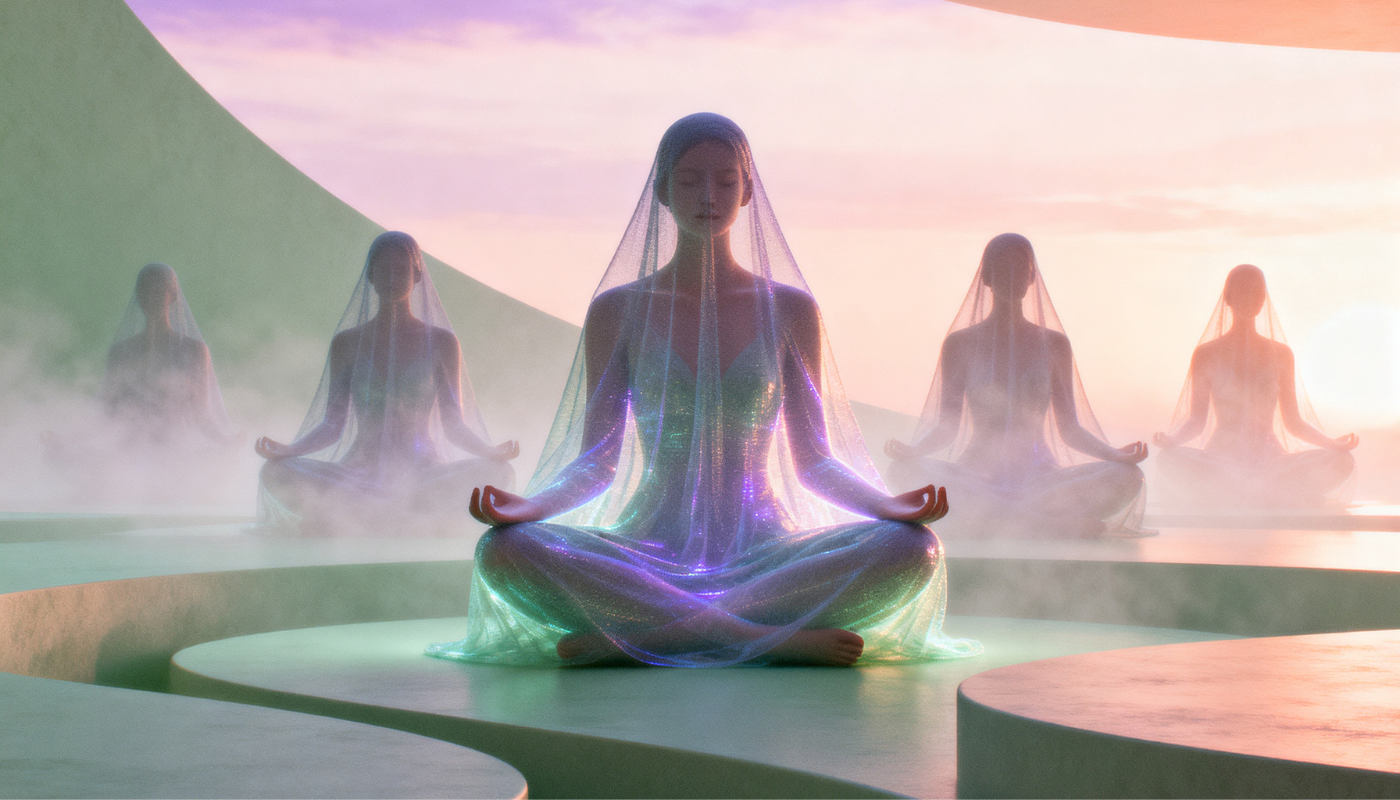
You have felt it for a long time. That you are more than the body in the mirror and more than the running commentary of the mind, and that the usual explanations, the colour-coded charts and the tidy diagrams, never quite reach the thing you are sensing. Here is what you are sensing. Beneath the physical body sits a subtle body, a layered energetic architecture that the yogic tradition mapped with remarkable precision thousands of years ago. It is called the sukshma sharira, and its five layers, the koshas, describe the whole passage from the flesh you can touch to the essence you have only glimpsed. This is the map.
We want to walk the whole of it with you, because once you can see the layers clearly, a great deal of what has felt confusing about your own inner life begins to make sense.
The subtle body is the field of energy, breath, mind, and awareness that animates the physical form and extends beyond it. Where the physical body is made of dense matter, the subtle body is made of prana, the life force, and of the finer movements of thought and feeling that most instruments will never measure and every human being can feel.
The tradition describes three bodies, not one. There is the sthula sharira, the gross or physical body, the vehicle you were born into and will one day leave. There is the sukshma sharira, the subtle body, which carries your vitality, your emotions, your discernment, and your sense of self. And there is the karana sharira, the causal body, the deepest seed layer where your karmic patterns rest before they ever express themselves in thought or form. When people speak loosely about the "energy body" or the "aura," what they are usually reaching for is this middle body, the subtle one, and its layers have names.
.png)
The clearest map of the subtle body comes from the pancha kosha model, first described in the Taittiriya Upanishad. Kosha means sheath, or covering. Picture five sheaths nested one inside the other, each finer than the last, moving from the dense outer layer of the body inward toward the still centre of pure being. This is the same movement your own practice already follows, from the gross to the subtle, and naming it gives you a way to know exactly where you are.
Annamaya kosha, the sheath of food. This is the physical body, built from and sustained by what you eat. It is the densest layer and the one modern medicine knows best. It holds your posture, your fatigue, your health, and every sensation you have ever called physical. For most people this is where attention lives almost entirely, which is precisely why so much goes unheard.
Pranamaya kosha, the sheath of vitality. Here lives prana, the life force that moves through the body along channels called nadis. This is the layer of your energy in the truest sense, the felt charge that rises when you are inspired and drains when you are depleted in a way that sleep alone will not restore. When you walk into a room and feel its atmosphere before a single word is spoken, you are reading the pranamaya layer. The chakras belong here.
Manomaya kosha, the sheath of mind. This is the layer of thought and emotion, of moods and reactions, of the running commentary that narrates your days. It is also where your conditioning lives, the grooves that the tradition calls samskaras, the automatic patterns that fire before you have chosen anything. Much of what feels like a personality is activity in this sheath, and much of the work of waking up is learning to watch it rather than be moved helplessly by it.
Vijnanamaya kosha, the sheath of wisdom. Beneath the restless mind sits buddhi, the faculty of discernment and deep knowing. This is the layer of intuition and of the witness, the sakshi, the quiet awareness that can observe a thought without becoming it. When you catch a spiral before it completes, when you sense the truth of something before you can argue it, you are drawing on this sheath. It is the beginning of real freedom, because from here you are no longer fully identified with the mind's weather.
Anandamaya kosha, the sheath of bliss. The innermost layer, closest to the essence, is one of pure being. The bliss named here is not a passing happiness that depends on circumstance. It is the ground that remains when everything else grows quiet, the spaciousness that experienced meditators touch in the deepest stillness. It is the last veil before pure consciousness itself.
The koshas are nested, not stacked. You do not abandon one layer to reach the next. You move inward through them, so that a genuine practice touches the body, the breath, the mind, the discernment, and the being all at once, each one a doorway to the one beneath it.
.png)
If you have worked with the chakras before, you now have a home for them. The chakras are concentrations of prana within the pranamaya kosha, meeting points where the nadis converge and life force gathers and turns. This is why serious chakra work is never about decoration or a colour to visualise. It is about the actual movement of prana through the vital sheath, the quality of energy at each centre, and what happens to your whole system when that flow is clear or blocked.
Holding the chakras inside the kosha map keeps them precise. They are one feature of one layer of a much larger architecture, and they behave differently depending on what is happening in the sheaths around them. A block that looks energetic often has its root in the mental sheath, in a samskara that keeps re-firing. The map lets you trace the thread rather than treat the symptom.
.png)
Here is where the whole model becomes deeply practical. Because the sheaths are nested and continuous, what moves in a finer layer eventually expresses itself in a denser one. A grief held in the mental sheath can settle as a tightness in the chest. A prolonged depletion in the vital sheath can show up as a physical exhaustion that no amount of rest resolves. The body becomes a messenger, carrying upward and outward what the subtler layers are holding.
This is what we mean when we say the body is a map. The physical form is often the last place a pattern arrives, which makes it a reliable place to read one. When you learn to treat a symptom as information rather than only as a problem to silence, you gain access to a layer of self-knowledge that most people never reach, because they were taught to address only the outermost sheath and to call everything beneath it imagination.
Learning to listen at this depth is a practice, and it is one we built the Highest Self workbook to hold. If you want a structured way to move inward through these layers rather than improvising, that is the room it opens.
You do not need to master all five sheaths to begin. You need to turn your attention, gently and consistently, in a direction most people never look.
Begin at the vital sheath through the breath. Pranayama, conscious breathing, is the most direct way to touch prana, because the breath is the bridge between the physical and the subtle. Even a few minutes of slow, aware breathing shifts the quality of the pranamaya layer in a way you can feel.
Then practise pratyahara, the drawing inward of the senses. This is the deliberate turning of attention away from the constant pull of the outer world and toward your inner landscape, paired with vairagya, a soft non-attachment to what you find there. Together they let you observe the mental sheath instead of being swept along by it.
Over time, the witness in the wisdom sheath grows steadier. You begin to notice the samskara before it completes, to feel the charge in a room and know it is not yours to carry, to rest for a moment in the quiet ground beneath the noise. This is the whole of the path in miniature, and it starts with a single choice to look beneath the surface you were told was all there is.
The one thing to carry from all of this is simple. You were never only the body in the mirror, and now you have the map that shows you the rest.
What is the difference between the subtle body and the aura?
The aura is a popular name for the felt or perceived field of energy around a person, which corresponds most closely to the pranamaya kosha, the vital sheath. The subtle body is the larger structure that contains that vital layer along with the mind and the discernment. The aura is one visible edge of a much deeper architecture.
Are the koshas the same as the chakras?
They belong to the same territory without being the same thing. The chakras are centres of concentrated prana within the pranamaya kosha, one layer of the five. The koshas are the full map, and the chakras are one important feature of it.
How do I know if my subtle body is out of balance?
The signs usually appear as patterns rather than single events. Persistent fatigue that rest does not touch, emotions that seem larger than their trigger, a sense of carrying energy that is not yours, or a feeling of being disconnected from yourself can all point to the subtler layers asking for attention. The body-as-a-map principle invites you to read these as information, and, where anything concerns your physical health, to seek appropriate care as well.
Can you actually feel the subtle body?
Yes, and you already have. The atmosphere of a room, the drain of certain company, the lift of a deep breath, the stillness that arrives in meditation, these are all direct experiences of the subtle layers. The practice is learning to notice them on purpose.
If this opened something, the Highest Self workbook is the structured path inward through exactly these layers. It is linked here whenever you are ready.






.png)

.png)
.jpg)