
There is a question that doesn't get asked often enough in spiritual spaces, and it's this: are you healing, or are you evolving? And more importantly, do you know which one this moment is actually asking of you?
Most of us begin the inner work through healing. Something happens, or something accumulates, and eventually we turn inward. We start to understand the patterns, the wounds, the beliefs formed in early childhood that have been quietly running the show. We do the work. Therapy, journaling, meditation, energy healing. We peel back layers. We learn the language of our inner world.
This is real and necessary work. There is nothing to skip here.
But at some point, something changes. The wound stops being the loudest voice in the room. We arrive at a kind of stillness that we don't quite know what to do with. And instead of recognising that stillness as a threshold, many of us step back from it. We go looking for more to heal. We return to the story, gather more evidence, go deeper into the origin. We call this growth, because for a long time, that is exactly what it was.
The problem is that healing and evolving are not the same process. They draw from different parts of you, they move in different directions, and they ask completely different questions.
Healing is the work of return. It moves toward wholeness, toward integration, toward the restoration of the parts of you that fragmented under the weight of experience. It is the process of bringing what was scattered back into relationship with the whole.
The orientation of healing is toward the past. It asks: what happened, and what did I make it mean? It looks at the wound and traces its roots. This is not pathological, it is necessary. We cannot build anything lasting on a foundation that has not been examined.
But healing has a destination. There is a point at which the work has done what it was designed to do. The wound has been understood, integrated, placed within a larger context. You can hold your history without being governed by it. You can tell the story without becoming it again in the telling.
This is wholeness. And wholeness, in the yogic understanding, is not a final state but a stable ground. It is the earth you stand on before you begin to move.
Evolution is the work of emergence. It moves toward becoming, toward transcendence, toward the version of you that exists beyond the story you've been living inside. Where healing draws from your wound, evolution draws from your potential.
The orientation of evolving is forward. It asks: who am I becoming, now that I am no longer defined by what happened to me? It does not look back at the origin of the pattern. It looks at the identity that has been constructed around that pattern, and asks whether that identity still fits.
This is the work that feels most destabilising, because it requires you to release something that has been providing structure. The healed self still has a story. It is a more coherent, more compassionate story than the one before it, but it is still a story. Evolution asks you to step beyond the need for that particular container.
In Kashmir Shaivism, this movement is understood as the soul's natural impulse toward its own nature, not as effort but as recognition. The self does not have to become something it is not. It has to stop insisting on being something smaller than it already is.
The crossing point is quieter than most people expect.
You stop returning to the same story with new evidence. The old wounds no longer generate your identity. You find that you can sit with your past without needing it to explain your present. There is a kind of spaciousness that opens up where the story used to live.
Most people experience this as loss. The story, even a painful one, has been the thing that made sense of them. Without it, there is a moment of genuine disorientation, a feeling of not knowing who you are without the context the wound provided.
This is the threshold. And it is precisely here that many people step backward. They return to the healing work, not because more healing is needed, but because the alternative, the open question of who you are becoming, feels like too much to hold.
Recognising this moment for what it is changes everything. The disorientation is not a sign that something is wrong. It is a sign that the ground beneath you has shifted, and that something larger is asking to emerge.
If you are in a healing process and you try to force evolution before the ground is stable, you will build on sand. The new identity will not hold because the old one has not been properly integrated. This is why some people can name every pattern they carry and still find themselves living inside those patterns, because knowing is not the same as integrating.
But the reverse is also true, and it is less often named. If you are ready to evolve and you keep returning to the healing work, you will mistake contraction for depth. You will keep circling the origin point, adding nuance and complexity to a story that has already given you everything it has to give.
The practice is discernment. The capacity to know, in any given moment, which process you are in, and what this particular season of your life is actually asking of you.
There is no formula for this. But there are questions that can orient you.
If you find yourself frequently returning to the same wound with the same emotional charge, if the story still has the power to collapse you or to define how you show up, the healing work has more to offer you. Give it your full attention without shame. There is no timeline on this.
If you find that you can hold your story with something close to equanimity, if the past feels like context rather than cause, if you sense that something in you is ready to move but you keep pulling it back toward familiar ground, you may be standing at the threshold of evolution. The question is not what else needs to be healed. The question is who you are becoming.
Both are serious, sustained practices. Neither is more spiritual than the other. What matters is that you are honest with yourself about which one is alive in you right now, and that you give it the kind of attention it deserves.
The inner work is not linear. There will be seasons of healing that interrupt periods of evolution, and there will be moments of genuine emergence that arise in the middle of deep repair. This is not failure. It is the actual texture of transformation.
What changes, when you understand the difference between the two, is that you stop judging your progress by the wrong measure. You stop asking "why am I not further along?" and start asking "what is this actually asking of me?"
That single shift in the question is, in itself, a form of evolution.
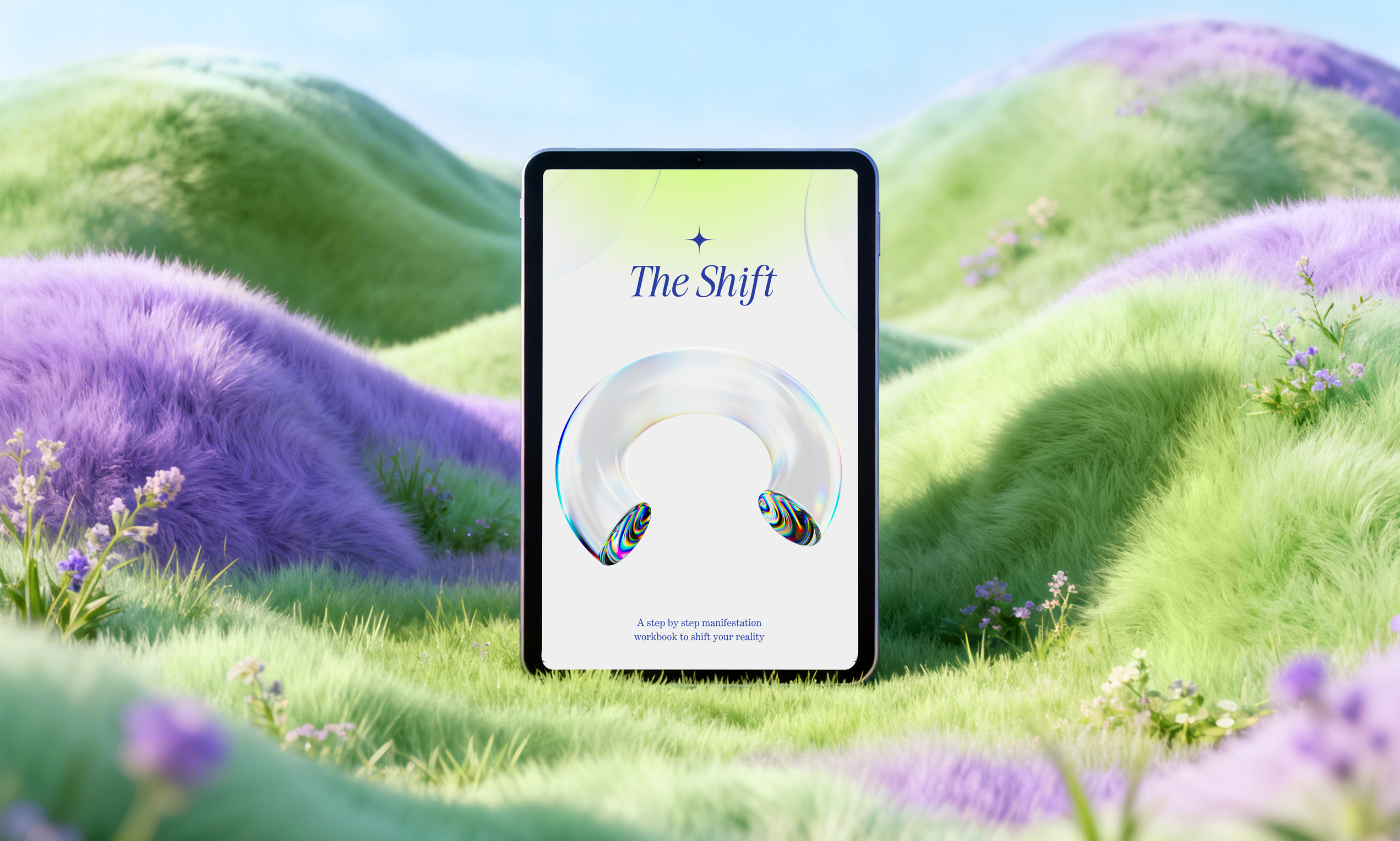
If you are in the middle of your own threshold moment and looking for structured support, the Higher Self Workbook was built for exactly this work. It is a guided process for the woman who has already gone deep and is ready to meet the version of herself waiting on the other side.







.png)

.png)
.jpg)