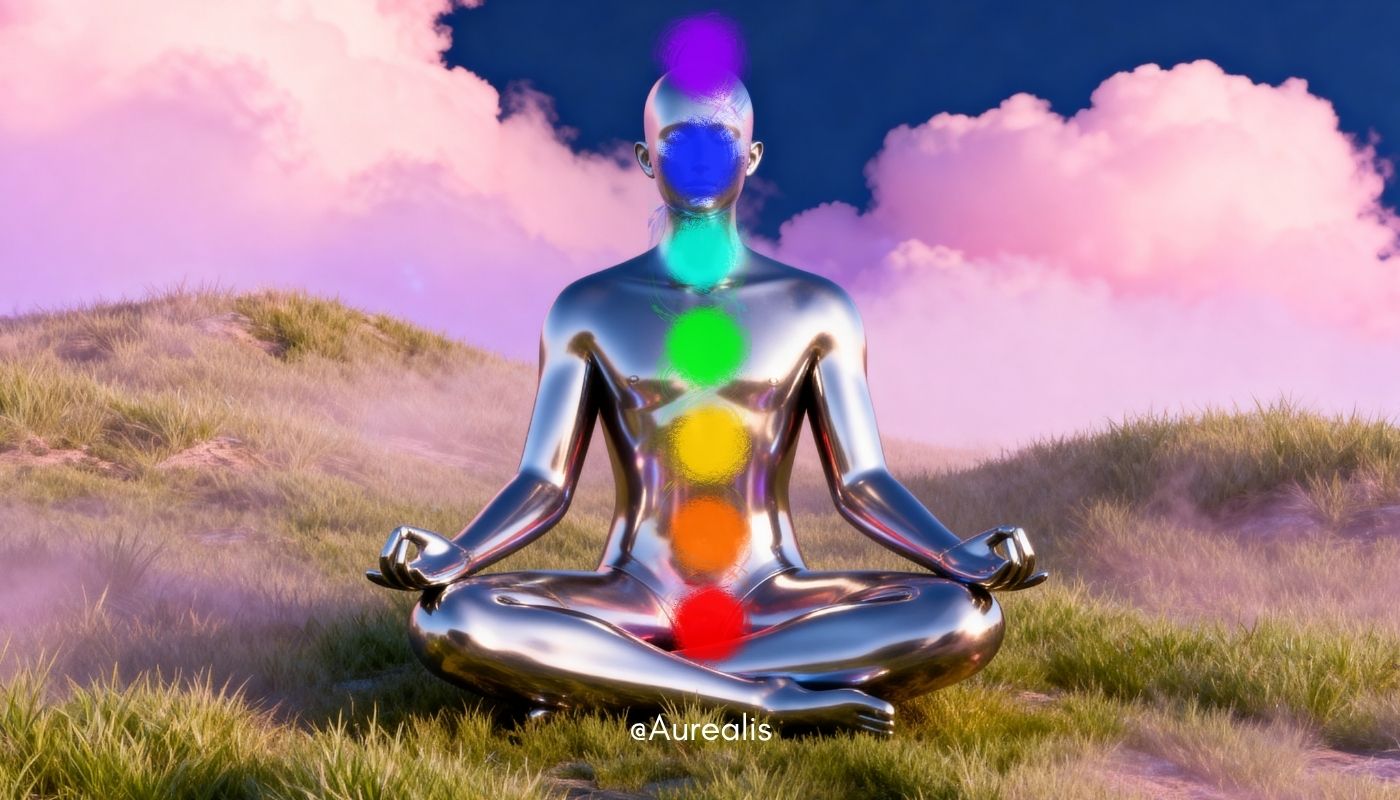
All of us are familiar with the chart: seven glowing discs stacked up the body like traffic lights, red at the base climbing through orange and yellow and green and blue to a violet crown, each one tagged with a tidy job. Root for safety. Throat for speaking your truth. It's everywhere, on candles and yoga mats and the boxes of teas that promise to align you.
Here is the thing almost nobody mentions.. That chart, the one we all treat as ancient sacred knowledge, is younger than colour television. The rainbow was mapped onto the chakras by a single author in California in 1977. I am not telling you this to sneer, because the modern version has helped a great many people and there is something real underneath it. I am telling you because the actual chakras, the ones the tradition spent centuries mapping, are older, stranger, and far more interesting than the gift-shop edition, and once you see them clearly you cannot unsee how much got lost along the way. So let me give you both. The honest history first, then the real thing.
Almost every element of the chakra system you know is pretty recent, and mostly from the West rather than from India. The rainbow colors are the clearest example. The clean spectrum, red root to violet crown, was the work of Christopher Hills, who mapped the seven centers onto the band of visible light in a 1977 book. Before him, back in 1927, a Theosophist named Charles Leadbeater had published his own colour scheme based on what he believed he was clairvoyantly seeing. Spoiler alert, it looked nothing like Hills's rainbow. Neither of them was passing down an ancient transmission. They were, in good faith, making something new. The scholar Kurt Leland, who traced this whole history in careful detail, puts the assembly of the version we now use as recently as 1977.
The tidy list of meanings is just as young. That familiar ladder of survival, sexuality, power, love, communication, intuition, and cosmic consciousness was largely worked out at the Esalen Institute in California in the 1970s. The link between the chakras and the endocrine glands came from Western color-healing circles earlier in the century. And the whole psychological reading, the idea that a chakra is "blocked" and that this explains something about your emotional life, owes an enormous amount to Carl Jung, who spent a 1932 seminar interpreting the chakras through his own psychoanalysis. The wellness version you know is, in a real sense, a collaboration between Indian tantra, Victorian clairvoyants, Swiss psychology, and the California counterculture.
There is a deeper point thought underneath all this. There was never one chakra system to begin with. The tradition held many. Depending on the text and the lineage, you find four center, or five, or six, or seven, or twelve or more. Their locations shifted. Their functions shifted, sometimes psychological, sometimes physiological, sometimes purely cosmological. What got handed to us as a single fixed anatomy was, in its own home, a living plurality. The seven-with-a-rainbow is one late systematisation of something that was all over the place.
None of this though makes the modern version worthless. It makes it modern. And knowing that frees you to go find the older thing, which is where this gets good.
Let's start with the word itself. Cakra simply means wheel, or circle. The centers are called wheels because they were experienced as spinning vortexes of energy, points where something gathers and turns. They are part of the subtle body, the layered energetic architecture that sits beneath the physical one. If you want to read more about out "bodies", the five koshas of the subtle body is the fuller map, and the chakras live within it. Specifically, they sit along the channels that the tradition calls nadis, the pathways through which prana, the life force, moves. Three of these matter most: sushumna, the central channel running up the spine, and ida and pingala, the cooling and heating currents that wind around it. A chakra is a place where these channels meet and prana concentrates. That is what a wheel actually is. A junction.
This is why the traditional images are not decorative, and reading them properly tells you everything about how different the real system is from the wellness one. Each chakra is drawn as a lotus with a specific number of petals, and every petal carries a Sanskrit letter. Those letters are more than ornament, having an actual meaning. They are seed sounds, vibrations, and across the lower six centres they distribute all fifty letters of the Sanskrit alphabet, with the crown holding them in symbolic thousandfold fullness. The petals represent the nadis converging there. The shape at the centre of each lotus marks its element.
Here is the classic seven, described the way the tradition holds them, with the pop labels quietly corrected as we go. Notice the real logic of the sequence, which the rainbow obscures completely. It is an ascent through the elements, from the densest to the most subtle, and finally beyond element altogether. It is the same movement from gross to subtle that runs through all of this work.
Muladhara, the root. At the base of the spine, its element is earth, its seed sound lam/lang, its lotus four-petalled. This is the ground, the foundation, where the coiled potential the tradition calls kundalini is said to rest. Earth, not the colour red, is the actual key to it.
Svadhisthana, the sacral centre. Below the navel, element water, seed sound vam/vang, six petals. Flow, fluidity, the watery and creative currents of life.
Manipura, the navel centre. At the solar plexus, element fire, seed sound ram/rang, ten petals. The seat of heat, digestion, and transformative power, the inner fire that cooks raw experience into something usable.
Anahata, the heart. At the centre of the chest, element air, seed sound yam/yang, twelve petals. Its name means "unstruck," after a sound that sounds without anything striking it, a lovely and precise image for the openness of the heart. This is the meeting point of the lower and upper centres, where the earthbound and the transcendent shade into each other.
Vishuddha, the throat. Element ether, or space, akasha, seed sound ham/eng, sixteen petals. This is the subtlest of the five great elements, the medium in which sound and word arise, which is why the throat centre carries expression, though the tradition means something far larger than "speaking your truth."
Ajna, the back of your eyes-center of your skull. I has only two petals, seed sound om. Here the two side channels, ida and pingala, are said to meet the central one. It is associated less with an element than with the awareness and with inner seeing, the place where duality begins to resolve.
Sahasrara, the crown. The thousand-petalled lotus at the top of the head, beyond the elements entirely. This is not really a centre to be worked on so much as the destination, the place of union, where the coiled energy that rose from the root finally arrives.
Even this seven is one arrangement among several. But held this way, as an ascent from earth through water, fire, air, and space, into awareness and then beyond it, all of them represents a map of the whole journey inward.
The chakras were not a diagnostic system. Nobody in the tradition was checking which wheel was "blocked" to explain why they felt shy at parties. The centers were focal points for meditation. You concentrated on them, visualised them, sounded their seed syllables, drew your breath and attention through them, as part of a demanding contemplative discipline aimed at one thing: the awakening of kundalini, that dormant energy at the base, and its rising up through sushumna, piercing each centre in turn, to union at the crown. The goal was liberation and not actually a "balanced" life. The chakras were only a mean to an end, not the end goal. The meditation was not to balance the chakras, it was just using them to achieve a greater goal.
This was an initiated practice, transmitted from teacher to student, embedded in a whole framework of preparation. The modern move, taking these focal points for deep meditation and turning them into a checklist of emotional symptoms to be soothed with the matching crystal, is not exactly wrong, but it is a very long way downstream. It psychologised and then commercialised what was once a rigorous inner technology. Understanding that does not require you to abandon the modern version. It just lets you know what you are actually holding, which is a gift-shop postcard of a place you can, if you want, actually go.
You do not need the rainbow, the crystals, or a diagnosis of your blocked throat. The traditional approach is quieter and more demanding than any of that, and also more available than you would think. At its simplest, working with a chakra means bringing steady attention to its location in the body, breathing into it, and resting your awareness there, along with "singing" its seed sound. This is how you learn to feel the subtle body directly, which is a real skill that grows with practice. The deeper forms of this, actual kundalini work, genuinely do belong with an experienced teacher, because the tradition surrounds them with preparation for good reasons, and this is one place where the reading is not the practice.
They are not physical organs. You will not find a wheel of spinning energy on a dissection table, and the popular idea that each chakra simply is an endocrine gland is a modern overlay, not a traditional teaching and not established science. If "real" means "a solid object Western medicine can point to," then no.
But the chakras were never claimed to be that. They are a map of inner experience, a way of describing and working with something subtle that you feel rather than dissect. The honest way to hold them is the same way you might hold any contemplative technology, as a practice to test. Sit with a centre, work with it over time, and notice what happens in your own experience. That is the only laboratory this was ever meant to be verified in, and it is available to you.
So the next time you see the seven-disc rainbow on a candle, you do not have to roll your eyes at it, and you certainly do not have to feel foolish for ever having loved it. It is a genuine, if very young, creation, and it has been a doorway for a lot of people, which is not nothing.
You just get to know now that it is just the postcard, not the country. Behind the tidy colors there is something a thousand years older and considerably stranger, a map drawn by people doing serious inner work with no candles for sale at the exit. And unlike most postcards, this one comes with an address. The place is real enough to visit, if you are willing to do the quiet, unphotogenic work of actually going. Which was always the point.
What are the seven chakras?
The classic seven are muladhara at the base of the spine, svadhisthana below the navel, manipura at the solar plexus, anahata at the heart, vishuddha at the throat, ajna at the brow, and sahasrara at the crown. In the tradition they ascend through the elements of earth, water, fire, air, and space, into mind and then beyond, mapping the journey inward. The seven-centre version is one of several arrangements the tradition used.
Are chakras real?
They are not physical organs and do not appear in anatomy, and the idea that each chakra is simply an endocrine gland is a modern addition rather than a traditional teaching. The chakras are better understood as a map of inner experience, a contemplative tool rather than a physiological fact. Whether they are "real" for you is something the tradition invites you to test in your own practice rather than settle in the abstract.
Are the chakra colors traditional?
No, at least not the rainbow you know. The red-to-violet spectrum was mapped onto the chakras by Christopher Hills in 1977, and an earlier, quite different color scheme came from the Theosophist Charles Leadbeater in 1927. Traditional texts describe specific colours for petals and elements, but the familiar rainbow is a twentieth-century Western creation.
Where do the chakras come from?
The concept comes from Tantric and yogic traditions in India, appearing in texts from roughly the eighth century onward, with many different systems using four, five, six, seven, or more centres. The detailed version that reached the West came largely through Sir John Woodroffe's 1918 translation of a 1577 Sanskrit text, later reshaped by Theosophists, Carl Jung, and the California counterculture into the system common today.
Can a chakra really be blocked?
The language of "blocked chakras" is mostly modern and psychological rather than traditional. In the older understanding, the concern was the free movement of prana through the channels and the rising of kundalini, not a checklist of emotional blockages. It can be a useful metaphor for where your energy or attention feels stuck, as long as you hold it as a metaphor rather than a diagnosis.
How do you work with chakras?
Traditionally, through meditation: bringing focused attention and breath to a centre, sometimes sounding its seed syllable, as part of a larger contemplative practice aimed at inner awakening. You do not need crystals or colour charts to begin. Deeper kundalini practice is best undertaken with an experienced teacher, since the tradition surrounds it with preparation for good reason. You can also work with them through different asanas from Yoga.






.png)

.png)
.jpg)