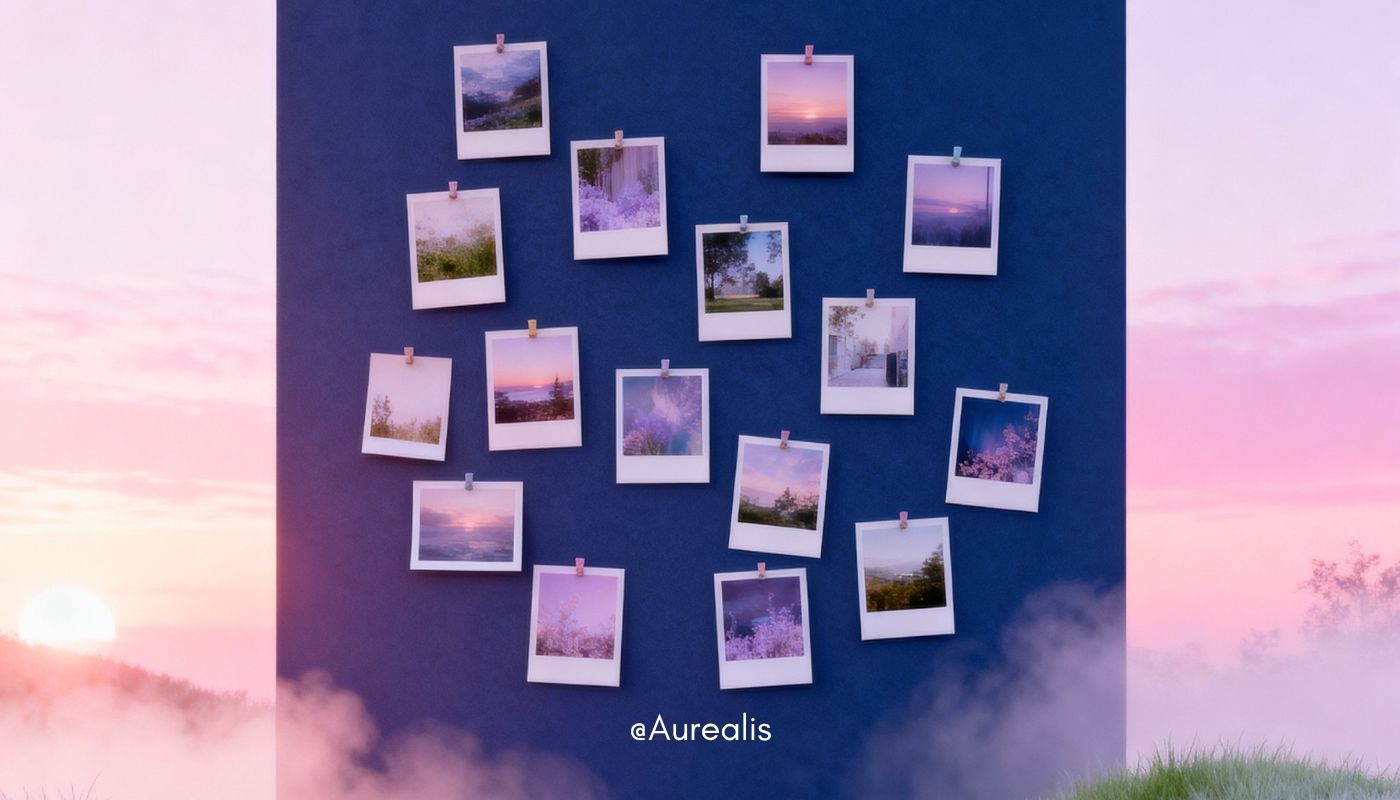
Let me tell you about my first vision board.
It had huge house with an amazing beach view and stunning design. It had a number I was slightly embarrassed to write down. And it had a photo of a couple laughing on a beach who were not me, and were never going to be me, and honestly looked a little smug about it. I looked at that board most mornings for about three weeks. Then I quietly stopped looking, because looking at it had started to feel like reading a menu in a restaurant I could not afford.
If you have ever made a vision board and felt that exact small deflation, the slow slide from excited to faintly mocked by your own wall, this is for you. Because the problem was never your dream, and it was not that you did not want it badly enough. It was that nobody told you what a vision board is actually for.
A vision board does not work because some cosmic delivery service reads your pictures and ships the matching items. If that were how it worked, we would all be living in that awesome house.
It works, when it works, through two very ordinary and very powerful mechanisms. The first is attention. Your brain is drowning in information every second and quietly filtering almost all of it out, showing you only what it has decided matters. What you look at often, with feeling, is how you tell it what matters. Point your attention at something consistently and you start noticing the doors, the openings, the small evidence you would have walked straight past a month ago. You are finally seeing the opportunities that were already there, not just randomly summoning them out of thin air.
The second is rehearsal. Athletes have used mental rehearsal for decades, running the race in their bodies before they run it on the track, because the nervous system does not draw a hard line between vividly imagined and lived. A vision board, used properly, is a rehearsal space. The most important part to remember is that it is a rehearsal for the state of being a person to whom those things are normal, not just for the actual objects.
Which means the board is a tool for your own mind, not a letter to the universe. That reframe changes everything about how you build it.
Most of them fail for the same reason mine did. They are built out of wanting.
A board assembled from longing becomes a daily monument to not having. Every image says, in a small voice you can feel even if you cannot hear it, you do not have this. You look at the house and some honest part of you registers the gap between the picture and your actual life, and instead of inspiration you get a low hum of lack. The board was supposed to pull you forward. But it can end up quietly confirming where you are stuck, which is the opposite of the job.
A lot of us put things on a board that we do not actually believe are possible for us. And a vision board is ruthless with that, because it puts the thing you secretly think you cannot have right in front of you every morning, and every morning some part of you argues back. This is the same gap the whole of real identity change is about. The board is a mirror showing you what you genuinely believe about yourself, and if the belief underneath is I am not someone this happens to, no amount of pinning will out-shout it.
So the fix is building the board from a completely different place.
The images are just some triggers, not the actual end point. What you are really building is access to a feeling.
Think about what you actually want when you want the big house. It is almost never the wallsl. It is the ease of a morning that is not rushed, the safety of a home that is fully yours, the quiet pride of having built a life that holds you. The object is a proxy for a state. And the state is the thing that does the work, because your baseline feeling, the emotional key you live in most days, is what you make your choices from, how you carry yourself, what you believe is available. Change the baseline and the choices change, and the choices are what build the life.
The traditions have always known this. There is an old idea, called Bhavana, the cultivated feeling-state, that says the seed of what comes is the feeling you steep yourself in now, not the thing you grasp at. Which is a very old way of saying that the felt-sense is upstream of everything.
So the practice is not staring at pictures. It is using the board to drop into the feeling of the life as though it were already ordinary. The way you would stand, breathe, answer the phone, move through a day, if this were simply your life and no longer a wish. You are rehearsing a state until your body stops treating it as foreign. This felt-sense work is exactly what we built The Shift around, because it is the part that changes things and the part almost every manifestation guide leaves out.
And feel it from wholeness. There is a version of visualising that is really just wanting with your eyes closed, and it deepens the lack. The version that works feels like something you already carry, offered a little more room. If that distinction is new, the real mechanics underneath manifestation are worth reading alongside this.
Start from the feeling rather than the object. Before you cut out a single image, ask what state you are actually after underneath the things. Safety. Freedom. Aliveness. Being deeply chosen. Name the real thing, because that is what you are building toward, and the objects are just its costume.
Then choose images that trigger that state, and be loose about what counts. A literal photo of the goal is fine, but so is a color, a texture, an ordinary moment, a face with the exact expression you want to wake up wearing. Some of the most powerful things on a board are not achievements at all. They are the quiet texture of the life, the light through a window, a hand holding a coffee, a version of you who looks at home in her own days.
Put who you are being on there too, not only what you are getting. This is the piece that turns a shopping list into an identity. Images of the qualities, the ease, the courage, the way of moving through the world, so the board is a picture of a self and not just an inventory of stuff.
Then place it where you will feel it, not just see it. Somewhere you pass with enough calm to actually drop in for a moment, rather than somewhere you will glance at while running out the door. And here is the real instruction: the practice is not the pinning, it is the two minutes. Once a day, look, and then close your eyes and feel it as already true. The board is the trigger. The felt state is the practice. Miss that and you have made lovely wall art.
One honest note before you go make yours, because I would be doing the whole thing a disservice otherwise. A vision board is not a substitute for living towards the life. It is a tuning fork, not a genie.
The feeling you rehearse each morning is meant to change how you move the rest of the day, the risks you take, the rooms you walk into, the things you finally let yourself ask for. If the board becomes a place you visit instead of a life you build, it quietly turns into a very beautiful form of avoidance. The tell is simple. A working board leaves you slightly braver when you walk away from it. A board that has become a hiding place leaves you soothed and unchanged. Watch for which one yours is doing, gently, without turning it into one more thing to fail at.
And do not, whatever you do, get precious about wanting nice things. There is a strain of spirituality that would have you feel shallow for putting a beautiful house or a car on a board, as if the enlightened move were to want nothing and photograph it. That is just the ego finding a more austere way to feel superior, and it is no freer than wanting the house. Desire is not the problem. Desiring from a place of lack, and mistaking the picture for the practice, is where it goes sideways.
So make the board. Put the smug beach couple on it if they make you smile. Then close your eyes, and instead of wanting the life, try on the feeling of already, quietly, being someone who has it. That small shift, from the reach to the having, is the entire thing nobody tells you, and it is the reason some boards gather dust and others slowly come true.
If you want a structured way into the felt-sense work underneath all of this, The Shift is built for exactly it, at whatever pace suits you.
Do vision boards actually work?
They can, though not the way most people think. A vision board works by focusing your attention so you notice more opportunities, and by letting you rehearse the feeling of the life you want until you begin acting from it. It does not work as a magical order form, and a board built from wanting rather than from a felt sense of already having tends to reinforce the lack instead.
How do I make a vision board that actually works?
Start from the feeling you are truly after rather than the objects, choose images that trigger that state including ordinary and textural ones, and include who you are being, not only what you are getting. Then place it where you can calmly drop into the feeling for a couple of minutes a day. The daily embodiment is the practice, and the board is simply the trigger for it.
Where should I put my vision board?
Somewhere you pass with enough ease to actually pause and feel it, rather than somewhere you only glance at in a rush. A bedroom wall, a desk, or a phone lock screen can all work. What matters is that the spot lets you drop into the feeling, not just register the images.
How often should I look at my vision board?
Once a day is plenty, as long as you are genuinely feeling the state rather than skimming the pictures. Two focused minutes of embodiment does far more than an hour of anxious staring. Consistency and the quality of the feeling matter more than frequency.
Should a vision board be physical or digital?
Either works, and the best one is the one you will actually engage with daily. Physical boards are harder to ignore and more tactile, while a digital board or phone wallpaper travels with you. Choose the format that makes the daily felt practice easiest to keep.






.png)

.png)
.jpg)